How Does Play Help Preschoolers Develop Early Reading and Math Skills?
Play helps preschoolers develop early reading and math skills by giving them meaningful opportunities to talk, tell stories, recognize letters and sounds, count, compare quantities, identify patterns, and solve problems. Activities such as pretend play, building with blocks, puzzles, games, songs, and hands-on exploration allow children to practice foundational academic concepts in ways that are engaging, memorable, and developmentally appropriate.
At Castle Creek Christian Academy, we know that some of the most meaningful learning happens when children are actively involved in what they are doing. Our Flower Mound preschool combines structured early academics with engaging experiences that help children build confidence, independence, curiosity, and a love of learning. Our Preschool Program introduces the Abeka curriculum, including phonics and foundational academic skills, while supporting the whole child through hands-on activities, social interaction, Christian teaching, and opportunities to explore. For families in Flower Mound, TX, this balanced approach means children can build important school-readiness skills while still experiencing the joy and discovery that should be part of early childhood.
Why Play-Based Learning Supports Early Literacy and Math Development
Play is not separate from learning. For preschoolers, it is one of the primary ways children explore ideas and put new skills into practice.
The National Association for the Education of Young Children (NAEYC) explains that play promotes language, cognitive development, self-regulation, social competencies, and knowledge across subject areas. The American Academy of Pediatrics also reports that developmentally appropriate play promotes cognitive and language skills while supporting executive function.
That makes purposeful play an important partner to intentional instruction. Teachers can introduce a concept, then give children opportunities to experience and apply it through games, conversation, movement, building, storytelling, and exploration.
How Does Pretend Play Build Early Literacy Skills?
Pretend play strengthens literacy because children use language for real purposes while creating characters, stories, and imaginary situations.
Imagine children turning part of a classroom into a grocery store. They might make a shopping list, recognize labels, create signs, ask a classmate what they want to buy, and pretend to take an order. To the children, they are playing. At the same time, they are practicing speaking, listening, vocabulary, storytelling, print awareness, and early writing.
NAEYC identifies reading, writing, speaking, and listening as key areas of early literacy and recommends incorporating literacy materials throughout preschool learning spaces. Examples include menus and order slips in dramatic play areas, writing materials in math and science centers, and environmental print throughout the classroom.
Play can reinforce literacy through:
- Storytelling: Children develop narrative skills by inventing characters and events.
- Conversation: Playing with teachers and classmates introduces new vocabulary and encourages children to express ideas.
- Writing: Signs, lists, menus, labels, and pretend notes give writing a purpose.
- Sounds and letters: Rhyming games, songs, and playful word activities help children notice how language works.
- Comprehension: Acting out familiar stories encourages children to think about characters, sequences, and meaning.
For preschoolers, these experiences help make language something they actively use rather than something they simply memorize.
How Do Blocks, Games, and Puzzles Teach Preschool Math?
Hands-on play helps children understand math by making abstract ideas such as numbers, shapes, size, patterns, and measurement concrete.
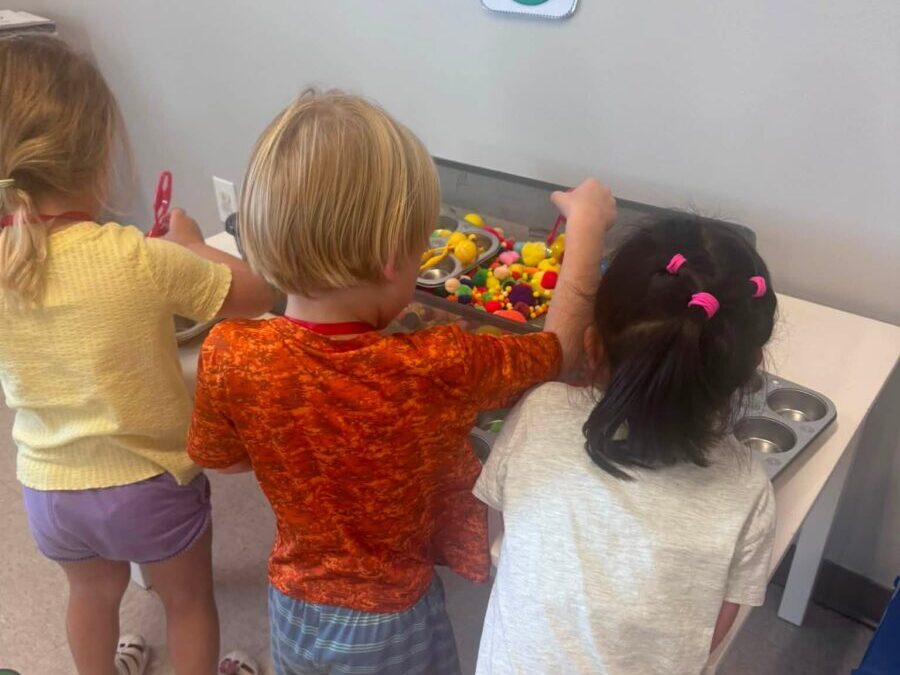
A child building a block tower may count how many blocks are used, compare which tower is taller, choose shapes that fit together, or figure out how to make the structure balance. A simple board game can involve counting spaces and recognizing quantities. Sorting buttons or toys can introduce classification and patterns.
NAEYC notes that early childhood mathematics includes counting and operations, spatial relationships, measurement and data, and patterns and algebra. Its guidance emphasizes building on mathematical ideas through playful and intentional experiences.
Everyday play can introduce concepts such as:
- Counting and one-to-one correspondence
- Number recognition
- Shapes and spatial relationships
- Sorting and classification
- Comparing more, less, bigger, and smaller
- Creating and extending patterns
- Measuring length, height, or capacity
- Problem-solving and logical thinking
The goal is not simply getting the correct answer. Children are learning to think mathematically, test ideas, notice relationships, and try again when something does not work.
Is Play Enough to Prepare a Child for Kindergarten?
Play is an essential part of kindergarten readiness, but high-quality preschool combines play with intentional teaching, caring relationships, routines, and age-appropriate academic instruction.
Teachers play an important role in extending what children discover. For example, if children are building a tower, a teacher might ask, “Which tower has more blocks?” If children are pretending to run a restaurant, the teacher might introduce menus, pencils, numbers, or new vocabulary.
This approach is sometimes called guided or intentional play. The adult creates an environment that encourages exploration while asking questions and introducing concepts that move learning forward.
At Castle Creek Christian Academy, preschoolers receive a balanced experience. Children begin exploring letter recognition and sounds through a multi-sensory approach, develop fine motor abilities through activities such as drawing and using scissors, build independence, and grow socially and spiritually.
What Can Parents Do at Home to Build Literacy and Math Through Play?
Parents do not need expensive educational toys to turn everyday play into learning. Conversation, household objects, books, outdoor exploration, and simple games can provide valuable opportunities.
Try activities such as:
- Build together. Count blocks, compare towers, discuss shapes, or predict what will happen if a block is removed.
- Create a pretend store. Make shopping lists, count pretend items, sort products, and make simple price tags.
- Play rhyming games. Think of words that rhyme or listen for beginning sounds.
- Go on a shape hunt. Look for circles, rectangles, triangles, and other shapes around your home or while exploring Flower Mound.
- Read and reenact stories. After reading a favorite book, use toys or costumes to act out what happened.
- Cook together. Count ingredients, compare amounts, notice numbers, and introduce measurement words.
- Ask open-ended questions. Try, “What do you think will happen next?” or “How could we make this taller?”
NAEYC encourages families to play with children because engaging play supports curiosity, problem-solving, attention, persistence, and other approaches to learning.
These activities also strengthen executive function. According to Harvard’s Center on the Developing Child, playful activities can help children practice attention, working memory, and self-control, skills that support learning well beyond preschool.
Frequently Asked Questions About Play and Preschool Learning
Does play really count as learning in preschool?
Yes. NAEYC identifies play as an important way young children develop language, cognitive, social, and self-regulation skills. Effective preschool programs intentionally connect playful experiences with learning goals.
What types of play are best for early math skills?
Building with blocks, puzzles, board games, sorting activities, pretend stores, cooking, pattern games, and shape hunts can all develop early mathematical thinking. Adult questions can extend the learning by encouraging children to count, compare, predict, measure, and explain their reasoning.
How does play prepare children for reading?
Play supports reading readiness by developing vocabulary, listening comprehension, storytelling, print awareness, early writing, and awareness of letters and sounds. NAEYC identifies language and knowledge, print concepts, sounds and letters, writing, and text comprehension as important areas of early literacy development.
Should preschoolers use worksheets instead of playing?
Worksheets are not a replacement for active, hands-on learning. Young children benefit from developmentally appropriate experiences that combine intentional instruction with opportunities to talk, move, experiment, create, and play. NAEYC describes high-quality preschool learning as active, hands-on, and “minds-on.”
See Learning Come to Life at Castle Creek Christian Academy
Play gives preschoolers a powerful way to practice the building blocks of reading and math while developing curiosity, confidence, communication, problem-solving, and independence. When purposeful play is paired with caring teachers and intentional instruction, everyday experiences can become meaningful opportunities to prepare children for kindergarten and beyond.
At Castle Creek Christian Academy, we provide Flower Mound children with a nurturing, Christ-centered environment where academic foundations, character, faith, creativity, and exploration can grow together. Contact us today to schedule a tour or learn more about our Flower Mound preschool programs.