What Should Parents Look for When Choosing a Christian Preschool in Flower Mound, TX?
Parents choosing a Christian preschool in Flower Mound, TX should look for a program that combines authentic faith-based teaching with developmentally appropriate academics, caring teachers, a safe environment, strong family communication, and opportunities for social, emotional, physical, and spiritual growth. The best fit should reinforce your family’s values while helping your child build confidence, independence, friendships, and kindergarten-readiness skills.
Choosing a preschool is about much more than finding convenient childcare. For many Christian families in Flower Mound, it means finding teachers and a school community they can trust to nurture both their child’s mind and heart. Castle Creek Christian Academy provides early childhood education rooted in Christian values, with a focus on helping children grow academically, socially, emotionally, physically, and spiritually. Our preschool program introduces a Christian curriculum while encouraging independence, character development, and meaningful learning experiences. We also recognize that parents are essential partners in a child’s development, which is why family involvement and communication are important parts of the preschool experience.
How to Choose a Faith-Based Preschool in Flower Mound
A quality Christian preschool should offer more than Bible stories alongside a traditional preschool curriculum. Parents should look at how faith, academics, relationships, play, and character development work together throughout the child’s day.
Research supports this whole-child approach. The National Association for the Education of Young Children (NAEYC) defines developmentally appropriate practice as a strengths-based, play-based approach that promotes learning across children’s developmental domains. NAEYC also identifies caring learning communities, meaningful curriculum, family partnerships, assessment, effective teaching, and educator professionalism as key areas of early childhood practice.
When touring a preschool, consider these five areas:
- How Christian beliefs and values appear in everyday classroom life
- Whether teaching methods are appropriate for preschool-age children
- How teachers interact with and respond to children
- How the school communicates and partners with parents
- Whether children have opportunities to grow academically, socially, physically, emotionally, and spiritually
How Should Faith Be Incorporated Into a Christian Preschool?
Faith should be part of everyday learning, relationships, and character development, not simply an isolated Bible lesson.
Ask prospective schools what children actually experience during a typical week. Do teachers model kindness, honesty, gratitude, compassion, and respect? Are biblical truths presented in ways young children can understand? Does the school’s approach to discipline and relationships reflect the Christian principles it teaches?
At Castle Creek Christian Academy, faith is integrated throughout the preschool experience. Children receive Bible teaching and biblical character-building alongside academics, and the academy’s philosophy emphasizes teaching, modeling, and interaction as ways to reflect God’s love. Chapel is also part of the school routine.
For parents, the practical question to ask during a tour is simple: “What would I see during an ordinary school day that shows me this is a Christian preschool?”
A strong program should be able to provide specific examples.
What Should a Preschool Curriculum Include?
A strong preschool curriculum should build early academic skills without overlooking play, exploration, creativity, movement, relationships, and independence.
NAEYC notes that play supports self-regulation, language, cognitive development, social skills, physical development, and problem-solving. Its guidance emphasizes that effective early education is not a choice between unstructured play and constant direct instruction. Children benefit from intentional learning environments that include meaningful opportunities to play and explore.
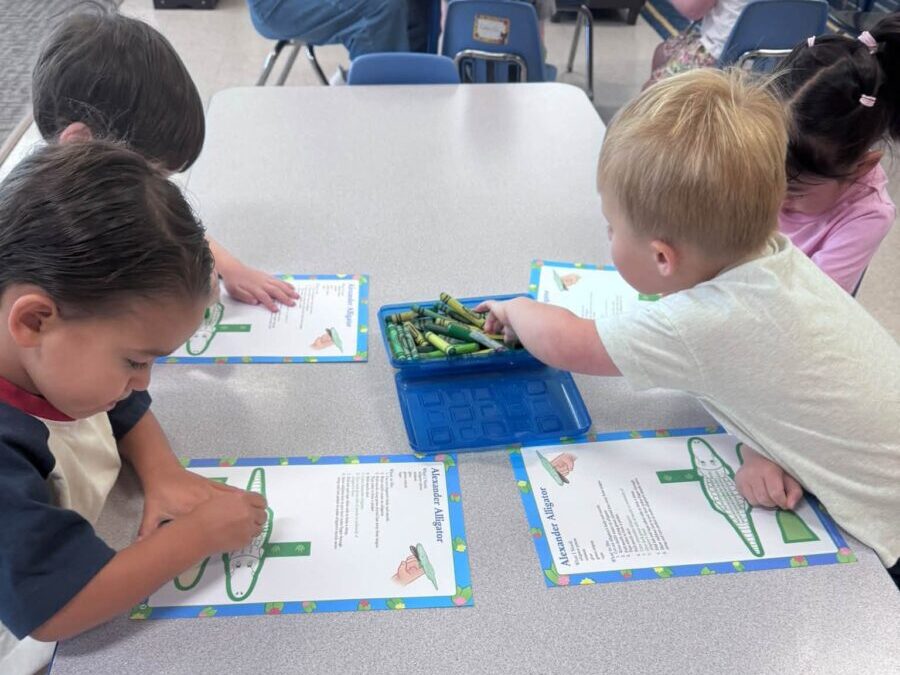
At Castle Creek Christian Academy, preschoolers are introduced to the Abeka curriculum through a Christian worldview. The program includes early phonics and language development, mathematics, Bible teaching, fine-motor development, Spanish, music, art, character-building, and physical activity.
When visiting a Flower Mound preschool, look beyond worksheets or lesson plans. Watch whether children are actively engaged, asking questions, interacting with teachers, using their imaginations, and developing age-appropriate independence.
Why Do Teacher-Child Relationships Matter So Much?
Warm, responsive relationships with teachers are a foundational part of healthy early childhood development.
Harvard University’s Center on the Developing Child explains that responsive, back-and-forth interactions between children and caring adults, sometimes called “serve and return,” play an important role in shaping brain architecture. These interactions support early language and social development and contribute to children’s emotional well-being.
That makes teacher interaction one of the most important things to observe on a preschool tour.
Notice whether teachers:
- Get down to children’s eye level and listen to them
- Respond warmly when a child needs reassurance
- Encourage questions and exploration
- Help children work through disagreements constructively
- Recognize individual personalities, abilities, and needs
- Make the classroom feel welcoming and emotionally safe
A beautiful facility and impressive curriculum matter, but the adults who interact with your child every day matter even more.
How Important Is Communication Between Preschool and Parents?
Consistent parent-school communication helps create continuity between what children experience at home and what they learn at preschool.
NAEYC identifies reciprocal partnerships with families as one of the major areas of developmentally appropriate early childhood practice. Its guidance for high-quality preschool programs encourages teachers to listen to families’ goals and concerns, invite participation, respect individual families, and communicate about children’s development.
Ask how a preschool handles everyday updates, developmental milestones, behavioral concerns, classroom changes, and questions from parents. Communication should not occur only when something goes wrong.
Castle Creek Christian Academy specifically encourages parental involvement as children progress through its preschool program.
What Should Parents Look for During a Preschool Tour?
Look at what children and teachers are actually doing, not just what appears in a brochure.
As you tour Christian preschools in Flower Mound, observe whether children seem comfortable, engaged, and known by their teachers. Look for organized spaces that allow children to explore safely, and ask how the school approaches academics, discipline, faith, security, communication, and transitions.
NAEYC identifies potential warning signs such as classrooms where children have little opportunity to explore, teachers who rarely engage with children’s activities, discipline centered primarily on punishment, or programs that rarely communicate children’s progress to families.
For Flower Mound families balancing work, church, school schedules, and activities throughout Denton County, practical considerations matter too. Ask about school hours, transportation, extracurricular activities, and how the program accommodates your family’s daily routine. Castle Creek Christian Academy is located on Bryce Lane in Flower Mound and serves families in the surrounding Flower Mound, Highland Village, and Lantana areas.
Frequently Asked Questions About Christian Preschools in Flower Mound
What makes a Christian preschool different from a traditional preschool?
A Christian preschool intentionally integrates biblical teaching and Christian character development into children’s everyday learning and relationships. Parents should still expect a high-quality program to provide developmentally appropriate academics, play, social development, physical activity, and preparation for future schooling.
Should preschool focus on academics or play?
Children need both intentional teaching and meaningful play. NAEYC identifies play as a central early childhood teaching practice and notes connections between play and language, self-regulation, problem-solving, social skills, and other foundational abilities.
What questions should I ask when touring a Christian preschool?
Ask how faith is incorporated into a normal day, what curriculum is used, how teachers handle discipline and separation anxiety, how much time children have for play and movement, how progress is communicated to parents, and how the program prepares children for kindergarten.
Does Castle Creek Christian Academy use a Christian curriculum?
Yes. Castle Creek Christian Academy uses the Abeka Christian curriculum, which includes early phonics, mathematics, social studies, science, and Bible teaching. Preschool students also participate in enrichment experiences such as Spanish, music, art, biblical character-building, and physical activity.
Find the Right Christian Preschool for Your Family
Choosing a Christian preschool in Flower Mound means finding a place where you feel confident about what your child is learning, how your child is treated, and the values being reinforced each day.
At Castle Creek Christian Academy, we strive to nurture the whole child by combining Christian values, purposeful academics, caring relationships, character development, and opportunities to become increasingly confident and independent.
Ready to see what a Christian preschool experience can look like for your child? Contact Castle Creek Christian Academy to schedule a tour and learn more about our preschool program in Flower Mound, TX.